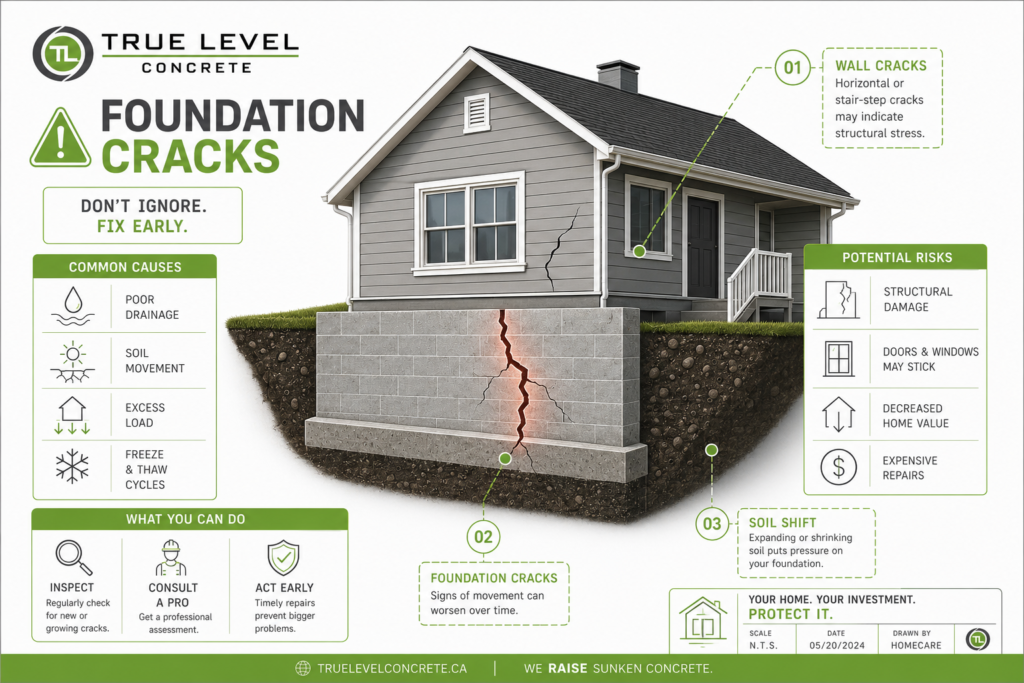
You’re walking through your basement, and there it is: foundation cracks running across the concrete wall. Your mind immediately goes to worst-case scenarios. Is the house shifting? Is the foundation failing? Do you need to call a structural engineer, a contractor, or just move?
Here’s the truth: not every foundation crack signals disaster. Some are cosmetic, some need monitoring, and some genuinely require fast professional attention. The difference comes down to four factors: the direction of the crack, its width, its location, and whether it’s actively growing. Once you understand those four criteria, you can stop guessing and start making smart decisions. That’s exactly what this article covers, along with what repairs typically cost and why getting a free written inspection from a reputable foundation specialist is the smartest first move when you’re not sure what you’re looking at.
The four types of foundation cracks and what each one signals
Vertical and hairline cracks: the least alarming kind
Vertical cracks run straight up and down the wall, and they’re the most common type homeowners find. Most of them form during the natural curing process as concrete loses moisture and shrinks slightly over the first few years after construction. Hairline foundation cracks, typically in the range of 1/16 to 1/8 inch wide, in newer homes are nearly always cosmetic and reflect normal drying, not structural failure. Because published thresholds vary slightly by source, the safest approach is to treat anything under 1/16 inch as normal curing, and anything approaching 1/8 inch as worth monitoring even if it isn’t yet urgent.
That said, vertical cracks still deserve periodic monitoring. A crack that was dry last year and is now letting water seep through after a rainstorm has crossed from cosmetic into functional problem territory, even if the structure itself is still sound.
Diagonal cracks: the differential settlement signal
Diagonal cracks run at an angle across the wall, and they form when one section of the foundation settles faster than another. That uneven movement creates tension across the wall, and concrete fractures at the path of least resistance. You’ll often notice related symptoms elsewhere in the house: doors that stick or won’t latch properly, cracks appearing above door frames on interior walls, or floors that slope noticeably in one area.
Diagonal cracks under 1/4 inch wide can be monitored initially, but any diagonal crack that grows over a few months, or measures wider than 1/4 inch, has moved beyond watch-and-wait. Differential settlement tends to continue unless the underlying soil issue is addressed.
Stair-step cracks in block and brick foundations
Stair-step cracks follow the mortar joints in block or brick foundations, climbing in a staircase pattern as the structure shifts unevenly beneath the surface. The triggers are typically soil washout, expansive clay swelling through moisture cycles, or tree roots disrupting the soil directly under the footing. Because the crack follows the weaker mortar rather than cutting through the block itself, the pattern can look less severe than it actually is.
These cracks indicate differential settlement, and they can worsen significantly if the soil problem causing the movement isn’t corrected. A stair-step crack that’s widening or climbing higher with each season is telling you something structural is actively changing beneath the foundation.
Horizontal foundation cracks: the most serious type
Horizontal cracks across a basement wall carry the highest structural risk of any crack type. They form when hydrostatic pressure from water-saturated soil, or expansive clay, pushes laterally against the foundation wall. Concrete can’t flex under that kind of force; it fractures horizontally instead. If the pressure continues unchecked, the wall can bow inward and eventually collapse.
Horizontal cracks typically appear midway down the basement wall, right where the lateral soil pressure is greatest. Unlike every other crack type, horizontal cracks warrant professional evaluation regardless of their width. A 1/16-inch horizontal crack is more urgent than a 3/8-inch vertical crack because the force driving it is structural, not cosmetic.
How to judge a crack’s severity using three practical criteria
Width thresholds: where cosmetic ends and structural begins
Width gives you the first useful data point. Cracks under 1/16 inch are typically the result of normal concrete curing and rarely indicate any structural concern. Cracks between 1/8 and 1/4 inch deserve closer attention, particularly if they’re diagonal or accompanied by other symptoms. According to HUD’s federal housing inspection standards, any foundation crack exceeding 1/4 inch, especially when combined with other indicators such as crack length or displacement, crosses into professional evaluation territory. The Concrete Foundations Association similarly identifies this threshold as the point at which a qualified assessment is warranted.
The exception, as noted above, is horizontal cracks. Those require professional evaluation at any width because the lateral wall pressure behind them is dangerous at every stage, not just when the crack is wide.
Active movement: the real warning sign
Width alone doesn’t tell the full story. A crack that has been sitting at 1/8 inch for fifteen years is a very different situation from one that’s grown from hairline to 1/8 inch in three months. Active movement changes the entire calculus. Signs of active movement include a crack that has clearly widened since you first noticed it, one that reopens after you’ve patched it, or one where the two sides are no longer flush with each other, one side is higher or pushed outward relative to the other.
The pencil-mark test is a practical monitoring tool any homeowner can use: mark both ends of the crack with a pencil, write the date next to each mark, and check back in 60 to 90 days. If the crack has extended beyond your marks or widened noticeably, you have documented evidence of active movement. That documentation removes the “wait and see” option and moves you into professional evaluation territory.
Location and pattern context
Where a crack appears matters as much as how it looks. Cracks near foundation corners, directly above door or window openings, or at the base of the foundation carry more urgency than isolated mid-wall cracks. Corners concentrate stress, and cracks near openings often indicate the foundation is transferring load unevenly through those weaker points.
Multiple cracks appearing together, especially in a consistent pattern, point to a systemic problem like settlement or drainage failure rather than a single isolated event. One hairline vertical crack is a normal aging sign. Five cracks appearing in different areas of the same wall over one season is a conversation starter with a foundation specialist.
Crack warning signs that should push you to act now
Bowing walls, water intrusion, and other structural red flags
Some combinations of signs indicate the situation has moved well past monitoring. A visibly bowed or bulging basement wall, even one that has shifted only an inch inward, is a serious structural concern that typically requires immediate stabilization. Water seeping through basement foundation cracks after heavy rain accelerates the damage by eroding the surrounding soil and weakening the concrete itself, creating a feedback loop that gets more expensive to break the longer it’s left alone.
Horizontal cracks that have appeared suddenly, particularly after a wet season or a period of heavy freeze-thaw cycling, should be treated as urgent. The conditions that form horizontal cracks don’t improve on their own.
Sticking doors, sloping floors, and the full picture
Foundation movement rarely stays contained to the foundation. As the structure shifts, the symptoms travel upstairs: doors that drag across the floor or won’t latch, windows that jam in their frames, floors that slope enough to send a marble rolling, and gaps forming between baseboards and the floor. These above-grade signs are the home communicating that the foundation movement is already substantial enough to affect the living space above it.
When two or more of these signs appear simultaneously, schedule a professional foundation inspection without delay. Each one alone might have an innocent explanation; together, they indicate a clear pattern that needs a professional’s eyes on it.
Repair options and what they typically cost in the U.S.
Epoxy injection and sealing for dormant, non-moving cracks
Epoxy injection is the right solution for cracks that have stopped moving. The process involves placing ports along the crack, sealing the surface, and injecting low-viscosity epoxy from the bottom upward until the crack is fully bonded. This restores structural continuity by essentially gluing the two sides of the fracture back together under pressure. It works well for isolated structural cracks where the underlying cause has been resolved, but it’s not the right tool for any crack that’s still actively moving.
In the U.S., foundation crack repair using epoxy injection typically runs $250 to $800 per crack, or roughly $15 to $30 per linear foot depending on length and access, making it one of the more accessible options for dormant cracks where no ongoing movement is present.
Wall anchors, piers, and underpinning for active structural movement
Bowing basement walls caused by lateral soil pressure are typically stabilized using wall anchors. A steel rod connects an interior wall plate to an anchor buried in stable soil outside the foundation. As tension is applied to the rod, it counters the hydrostatic pressure pushing the wall inward. The wall is immediately stabilized upon installation, with gradual correction happening over months as the anchors are periodically tightened during dry seasons. Individual anchor costs typically run $400 to $800, with full projects often totaling $3,000 to $10,000 or more depending on wall length and the severity of the bow.
Foundation settlement, the cause behind diagonal, stair-step, and some vertical cracks, is corrected using hydraulic steel push piers or helical piers, each suited to different soil conditions. Push piers are driven into stable load-bearing soil beneath the problem zone and used to lift the foundation back toward level. Helical piers, which screw into the ground rather than being hydraulically driven, are often used in softer or more variable soils. Per-pier costs typically run $1,500 to $2,800, with full projects commonly ranging from $10,000 to $30,000 or more depending on the number of piers required and regional labor costs.
For severe soil failure or deep settlement where piers can’t reach stable ground, underpinning is the next step. This process extends the foundation’s depth by excavating beneath it and pouring new concrete footings. It’s a more intensive solution, and costs typically start around $20,000 and climb based on the home’s size and the depth required.
Why a professional inspection removes the guesswork entirely
What a foundation inspector actually evaluates
A qualified foundation inspector goes well beyond what’s visible to the untrained eye. They assess wall plumb and bow using tools that detect even minor deflection, look for moisture patterns and staining that indicate drainage problems, evaluate the soil conditions around the exterior, and document interior symptoms throughout the home. That full-picture evaluation is what separates a professional diagnosis from a homeowner’s best guess, particularly when cracks are borderline and could reasonably be argued either way.
Getting a written assessment with no upfront commitment
Many foundation specialists offer free written inspections, and that’s where any homeowner with an uncertain crack should start. A written professional report documents the severity, identifies the root cause, and outlines repair options with realistic cost expectations, all before you’ve committed to spending a dollar on repairs. That combination of no financial obligation and documented findings is what makes the inspection the right first step, not an optional one.
True Level Concrete provides free written assessments specifically because homeowners shouldn’t have to guess whether a foundation crack is cosmetic or structural on their own. That written report also gives you something useful if you’re buying or selling a home, managing a property, or navigating an insurance claim. It’s documentation showing the condition has been professionally evaluated, which carries weight in every one of those situations.
What you should do next
The direction, width, location, and behavior of a foundation crack together tell a clear story once you know how to read them. Hairline vertical cracks get monitored. Growing diagonal or stair-step cracks get evaluated. Horizontal cracks get professional attention immediately, regardless of width.
Most foundation problems caught early are both fixable and far more affordable than the alternative. The window for lower-cost repair closes when active movement is left unchecked, and the cost gap between early-stage repair and late-stage remediation is significant. A crack that costs a few hundred dollars to address today can become a $10,000-or-more pier project within a few years if the settlement continues, a realistic scenario based on the typical cost ranges for each repair stage.
If you’ve spotted foundation cracks you’re not sure about, the smartest move is a professional inspection with a written report. There’s no financial obligation, no guessing, and no looming uncertainty over a problem that may be straightforward to fix. Get the facts first, and the right decision becomes obvious from there.
Frequently asked questions about foundation cracks
Are foundation cracks dangerous?
It depends on the type. Hairline vertical cracks from normal concrete curing are rarely dangerous. Horizontal cracks, bowing walls, and cracks that are actively growing are the ones that carry real structural risk. When in doubt, a professional inspection is the only reliable way to know.
How much does foundation crack repair cost?
Foundation crack repair costs vary widely based on the method required. Epoxy injection for a dormant crack typically runs $250 to $800 per crack. Wall anchor systems for bowing walls often total $3,000 to $10,000. Pier-based foundation stabilization, the most common fix for active settlement, generally ranges from $10,000 to $30,000 or more depending on the number of piers and regional labor rates. Underpinning for severe cases typically starts around $20,000. Getting a written inspection first gives you an accurate estimate for your specific situation before any money changes hands.
How do I know if a foundation crack is structural?
Width, direction, and movement are the three key indicators. Horizontal cracks are structural at any width. Diagonal or stair-step cracks wider than 1/4 inch, or any crack that’s actively growing, warrant professional evaluation. The pencil-mark test described above is a reliable way to document whether a crack is moving before you call a specialist.
Can I repair a foundation crack myself?
Minor cosmetic cracks, hairline vertical cracks that aren’t leaking or growing, can be filled with hydraulic cement or polyurethane foam as a temporary measure. But DIY patching won’t stop active movement, and it can obscure the crack from future professional evaluation. For anything beyond a clearly dormant, cosmetic crack, a professional assessment should come first.