A cracked driveway can look like a concrete problem, but the concrete itself is not always the root cause.
When sections of a driveway begin to sink, separate, or become uneven, the more important question is: why did the concrete move in the first place?
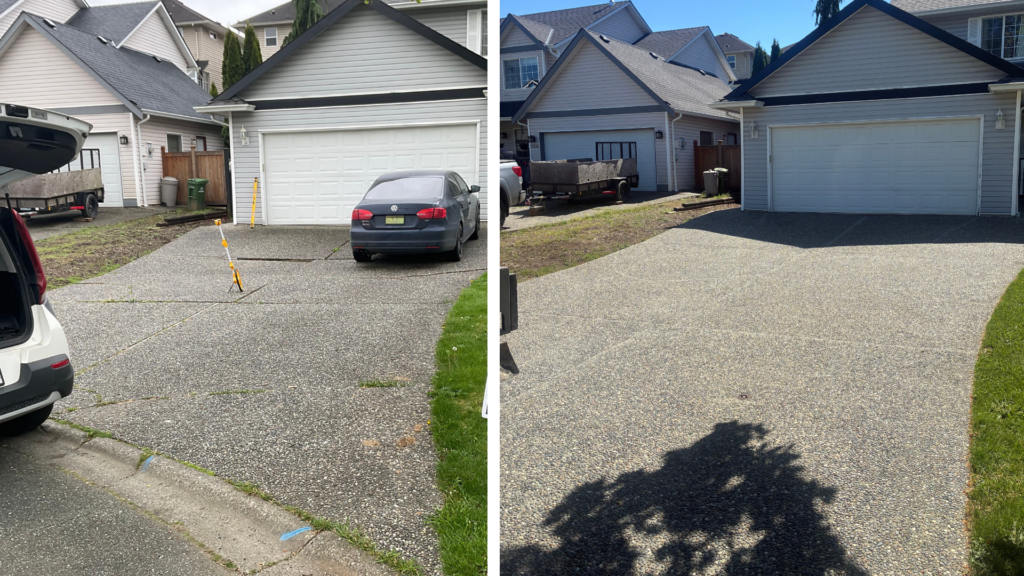
This recent True Level Concrete project in Chilliwack is a good example. The driveway had developed significant settlement, with multiple slabs sitting at different elevations and cracks forming through portions of the concrete. Instead of immediately removing and replacing the entire driveway, the existing concrete was assessed to determine whether it could be lifted, levelled, stabilized, and repaired.
The before-and-after photos show what can be achieved when the existing concrete is still a suitable candidate for restoration.
What Causes a Concrete Driveway to Sink and Crack?
Concrete is strong, but the soil and base supporting it can change over time.
Water is often an important factor. Poor drainage, erosion, improperly directed downspouts, changes in surrounding landscaping, or water moving beneath the slab can contribute to loss of support. Soil can also consolidate or settle over time, leaving spaces beneath sections of concrete.
Once a slab loses uniform support, gravity takes over. One section may settle while an adjacent section remains relatively stable.
That can create:
- Uneven joints between driveway slabs
- Trip hazards
- Cracks through individual slabs
- Low areas where water collects
- Separation between the driveway and garage
- An increasingly uneven or deteriorated appearance
This is why simply filling a crack doesn’t necessarily solve the underlying problem. If the slab is continuing to move because it lacks adequate support, repairing the surface alone addresses the symptom rather than the cause.
What Was Happening With This Chilliwack Driveway?
In the before photo, several distinct areas of settlement can be seen across the exposed-aggregate driveway.
Rather than having one flat, continuous surface, the slabs had shifted relative to one another. Cracking was also present, including through sections that had experienced movement.
That distinction matters.
A crack caused by an impact or surface deterioration is different from cracking associated with slab movement. Before recommending a repair, True Level Concrete looks at the condition of the concrete, the pattern of settlement and the conditions surrounding the affected area.
The goal isn’t simply to make the crack disappear.
It’s to determine why the concrete moved and what can reasonably be done to stabilize it.
Can a Cracked Concrete Driveway Be Lifted Instead of Replaced?
In many cases, yes.
A driveway doesn’t necessarily need to be demolished simply because it has settled or developed cracks.
If the concrete itself remains in serviceable condition, specialized concrete lifting techniques can be used to raise settled portions of the slab toward their intended elevation.
For this project, the objective was to correct the unevenness while preserving as much of the existing driveway as possible.
By carefully lifting and levelling the affected slabs, the substantial elevation differences visible in the original driveway could be reduced without tearing out the entire surface.
Why Stabilization Matters as Much as Lifting
Getting a slab back into position is only part of a successful concrete lifting project.
The slab also needs support.
When concrete settles, voids or areas of insufficient support may exist beneath it. During a lifting and stabilization project, material is introduced beneath the concrete at strategically selected locations to both raise the slab and help support it.
This distinction is important because the goal isn’t simply:
“Make the driveway look level again.”
It’s:
“Correct the settlement where practical and improve support beneath the affected concrete.”
Every project is different, however. Concrete condition, soil conditions, drainage, slab thickness, reinforcement, accessibility and the cause of settlement can all affect what can safely and realistically be achieved.
What About the Cracks After the Driveway Is Lifted?
Lifting a driveway doesn’t erase an existing crack.
Once concrete has fractured, the crack remains part of the slab. However, after the affected sections have been repositioned and stabilized, cracks can often be repaired or sealed as part of the restoration process.
That is an important expectation to set.
Concrete restoration is not intended to make an older driveway look like freshly poured concrete. The objective is to address the functional problem, reduce unevenness, stabilize the affected areas and improve the appearance of the existing concrete.
In this Chilliwack project, the finished driveway still looks like an existing exposed-aggregate driveway—which is exactly what it is—but the dramatic unevenness seen in the before photo has been corrected and the surface presents as a much more uniform driveway.
Should You Lift Your Driveway or Replace It?
There isn’t one answer that applies to every cracked driveway.
Replacement may be the appropriate solution when concrete is extensively deteriorated, severely fractured, structurally compromised, or otherwise unsuitable for lifting.
But when good concrete has settled because of conditions beneath it, removing the entire driveway can mean demolishing material that may still have considerable useful life.
That’s why True Level Concrete approaches these projects by first asking why the driveway failed.
If the existing slabs can be successfully lifted, levelled and stabilized, concrete restoration may offer homeowners an alternative to full removal and replacement—with considerably less demolition and disruption.