Mudjacking vs Polyurethane Foam Injection: What We’ve Learned from Decades of Concrete Lifting in British Columbia
Understanding Why Concrete Sinks
Before comparing repair methods, it’s important to understand what causes concrete settlement in the first place.
Contrary to popular belief, concrete rarely sinks because the concrete itself has failed. In most cases, the underlying soils have lost their ability to adequately support the slab. Through thousands of concrete lifting and stabilization projects across British Columbia, True Level Concrete has found that settlement is most commonly associated with:
- Soil erosion caused by water movement
- Poorly compacted fill soils
- Organic material decomposition beneath slabs
- Utility trench settlement
- Repeated freeze-thaw cycles
- Changes in soil moisture content
- Voids created by water infiltration
When support is lost beneath a slab, the concrete settles into the voids. The objective of any slab lifting system is to restore support, fill voids, and return the concrete to a safe and functional elevation.
Two Approaches to Concrete Lifting
Today, the two most common methods of slab lifting are traditional mudjacking and polyurethane foam injection.
While both methods can raise sunken concrete, they achieve the result in very different ways.
Traditional Mudjacking
Mudjacking, also known as slabjacking, has been used for decades throughout North America. The process involves drilling large holes through the concrete and pumping a cementitious slurry beneath the slab under pressure.
The slurry typically consists of:
- Portland cement
- Sand
- Water
- Various additives depending on the contractor
As material fills the void beneath the slab, hydraulic pressure develops and lifts the concrete upward.
For many years, True Level Concrete performed mudjacking because it was one of the most widely available repair technologies in the industry.
However, while mudjacking can successfully lift concrete, it has several limitations that become apparent over time.
The Challenges of Mudjacking
The primary challenge with mudjacking is the weight of the material being introduced beneath the slab.
A typical mudjacking slurry can weigh well over 100 pounds per cubic foot. In many settlement situations, the underlying soils have already demonstrated an inability to adequately support loads. Introducing additional weight can increase stress on those same soils.
Mudjacking also requires larger injection holes, typically ranging from 1 to 2 inches in diameter, which remain visible after repairs are completed.
In water-affected environments, cementitious materials may also be vulnerable to long-term erosion. If the original cause of settlement was water movement, ongoing soil loss can continue beneath the repair area.
Additional considerations include:
- Longer cure times
- Larger drill holes
- Increased cleanup requirements
- Reduced control during precision lifting
- Additional dead load placed on supporting soils
The Evolution to Polyurethane Foam Injection
As polyurethane injection technology became commercially available, the industry gained access to a material specifically engineered for soil stabilization and precision lifting applications.
Today, True Level Concrete utilizes PolyLevel®, a high-density structural polyurethane foam designed to lift, support, and stabilize settled concrete slabs.
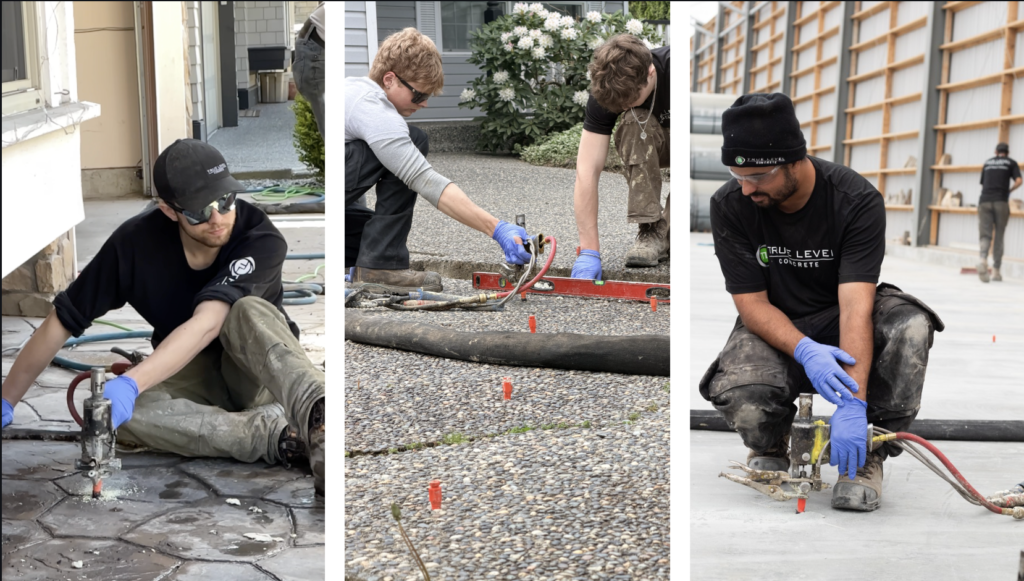
Unlike mudjacking, polyurethane foam is injected through small holes approximately the size of a penny.
Once injected beneath the slab, the material expands to:
- Fill existing voids
- Densify loose soils
- Restore contact between the slab and supporting soils
- Provide controlled lifting forces to raise settled concrete
Because the expansion process is gradual and controllable, technicians can make precise adjustments during lifting operations.
Why Material Weight Matters
One of the most significant differences between the two systems is density.
Polyurethane foam weighs only a fraction of traditional mudjacking material while providing substantial compressive strength once cured.
From a geotechnical perspective, this is important because settlement problems are often rooted in weak or compromised soils. Adding less weight while restoring support reduces the likelihood of introducing additional stress to already problematic ground conditions.
In practical terms, contractors can fill large voids and stabilize soils without significantly increasing the load beneath the slab.
Water Resistance and Long-Term Performance
In British Columbia, water is often a contributing factor in concrete settlement.
Heavy rainfall, poor drainage, broken downspouts, irrigation systems, and utility leaks can all contribute to soil erosion and void formation beneath concrete surfaces.
Polyurethane foam is hydrophobic, meaning it does not absorb water and is not susceptible to washout in the same manner as cement-based materials.
While correcting the source of water intrusion remains critical, the material itself maintains its structural properties when exposed to moisture.
This makes polyurethane particularly well suited for many of the settlement conditions commonly encountered throughout the Lower Mainland and Vancouver Island.
What We Have Observed in the Field
After transitioning from mudjacking to polyurethane foam injection, our team observed several operational advantages:
- Smaller and less visible repair holes
- Faster installation times
- Greater lifting precision
- Immediate structural support
- Reduced disruption to homeowners
- Ability to return concrete to service in as little as 30 minutes
- Improved performance in water-affected environments
Most importantly, polyurethane foam allows us to address both the symptoms and contributing factors of settlement by filling voids while also improving soil support conditions beneath the slab.
Which Solution Is Better?
Both mudjacking and polyurethane foam injection can successfully lift settled concrete.
However, when considering factors such as material weight, lifting precision, cure time, water resistance, aesthetics, and long-term performance, polyurethane foam has become the preferred solution for most residential and commercial applications.
That’s why True Level Concrete no longer performs traditional mudjacking.
As our understanding of soil behaviour and concrete settlement has evolved, so has the technology available to address it. Polyurethane foam injection provides a cleaner, lighter, and more technically advanced approach to concrete lifting—making it the clear choice for the vast majority of projects we encounter today.
The Bottom Line
Concrete settlement is rarely just a concrete problem—it’s usually a soil problem.
The most successful repairs don’t simply lift the slab. They restore support beneath it.
While mudjacking helped pave the way for modern slab lifting techniques, polyurethane foam injection represents the next generation of concrete stabilization technology. By filling voids, improving soil support, resisting water intrusion, and minimizing additional loading on weak soils, it offers a more sophisticated solution for today’s settlement challenges.
If you’ve noticed sinking concrete around your home or commercial property, the first step is identifying why it settled in the first place. Once the root cause is understood, the right repair solution becomes much easier to determine.
We’d love to hear from you! Contact us now for a free estimate.