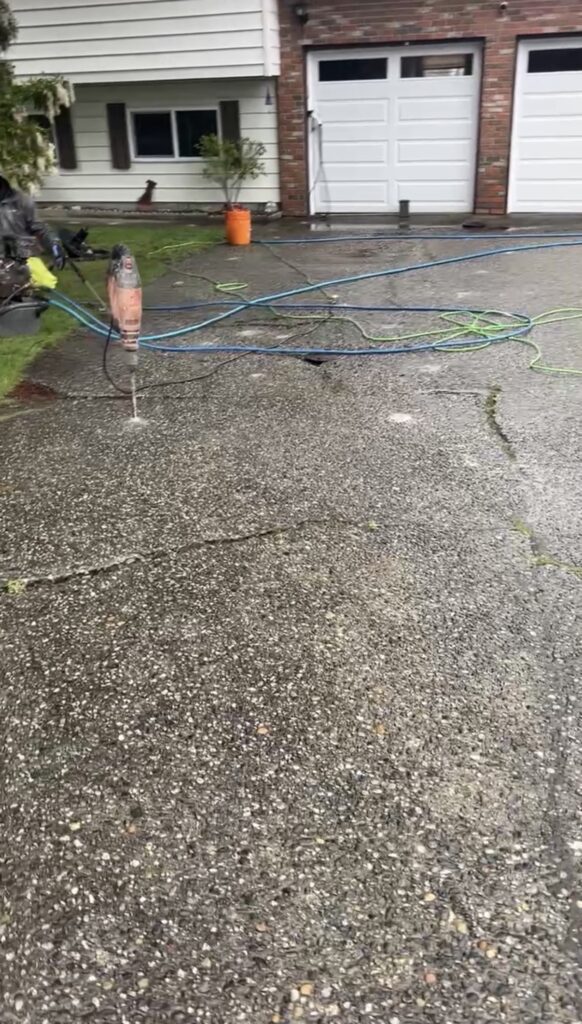
When homeowners look at a driveway covered in large cracks, uneven sections, or settled concrete, the first thought is often:
“I guess it needs to be replaced.”
In many cases, it doesn’t.
Over the last several years, concrete restoration technologies have advanced significantly. Today, many damaged driveways can be lifted, stabilized, and professionally repaired without demolition and replacement.
The result is a safer driveway, a dramatically improved appearance, and far less environmental impact.
Can a Severely Cracked Concrete Driveway Be Saved?
Concrete cracks for many reasons.
Sometimes it’s caused by soil settlement beneath the slab. Other times it’s years of seasonal expansion and contraction, poor drainage, or simply the natural aging of the concrete.
While some cracks indicate underlying structural movement that should be addressed, many driveways can be successfully restored by correcting the settlement first, followed by professional crack repair.
We’ve repaired driveways that homeowners assumed were beyond saving—transforming uneven, hazardous concrete into surfaces that are level, stable, and built to last.
A More Sustainable Approach
Every time a driveway is demolished, the environmental cost extends well beyond the job site.
Replacement typically involves:
- Demolishing existing concrete
- Hauling heavy debris to recycling or disposal facilities
- Manufacturing and transporting new concrete
- Additional equipment, fuel, and labour
- Days or even weeks of disruption
Whenever restoration is a suitable option, much of that environmental impact can be avoided.
By preserving the existing concrete, we’re extending the life of materials already in place rather than consuming new resources unnecessarily.
It’s an approach that’s good for homeowners—and good for the environment.
How We Lift Sunken Concrete
When a driveway settles, the problem usually isn’t the concrete itself.
The issue is often the support beneath it.
Using PolyLevel®, a high-density expanding polyurethane, small injection ports are drilled through the concrete. The material expands beneath the slab, filling voids, stabilizing the underlying soil, and precisely lifting the concrete back toward its original position.
The process is carefully controlled, allowing technicians to make fine adjustments while monitoring the lift.
Most homeowners are surprised by how small the injection holes are—and how quickly the work can be completed.
Environmentally Responsible Materials
One of the most common questions homeowners ask is:
“Is the material safe?”
It’s an important question.
The polyurethane used for concrete lifting is engineered specifically for below-slab stabilization applications. Once it cures, it becomes an inert, stable material that does not dissolve in water or continue reacting in the soil.
It is designed to remain in place beneath the concrete, providing long-term support without leaching into the surrounding ground under normal service conditions.
Just as importantly, because only small access holes are required, there is far less disturbance to landscaping, gardens, and surrounding property compared with complete concrete replacement.
Professional Crack Repair
After lifting and stabilization, visible cracks can be professionally repaired.
Immediately after completion, those repairs are often more noticeable because the repair material is fresh.
As the repaired areas weather naturally alongside the surrounding concrete, they typically become less visible over time.
Setting realistic expectations is an important part of every project.
Rather than promising perfection, we prefer showing homeowners real examples of completed repairs weeks and months later so they know exactly what to expect.
Leaving the Site Better Than We Found It
One of the things homeowners consistently comment on is how clean our crews leave the property.
Concrete restoration shouldn’t leave your home looking like a construction site.
Our crews take pride in protecting surrounding landscaping, minimizing dust, thoroughly cleaning the work area, and ensuring your driveway is ready to use as quickly as possible.
When the project is complete, our goal is simple:
Leave behind a safer driveway—not a mess.
Restore Before You Replace
Every driveway is different, and not every slab can be repaired.
But many homeowners are surprised to learn that what looks like a replacement project may actually be an excellent candidate for restoration.
If your driveway has settled, developed trip hazards, or accumulated years of cracking, it may be worth exploring whether lifting and repair can provide a long-lasting solution—while saving time, reducing waste, and extending the life of the concrete that’s already there.