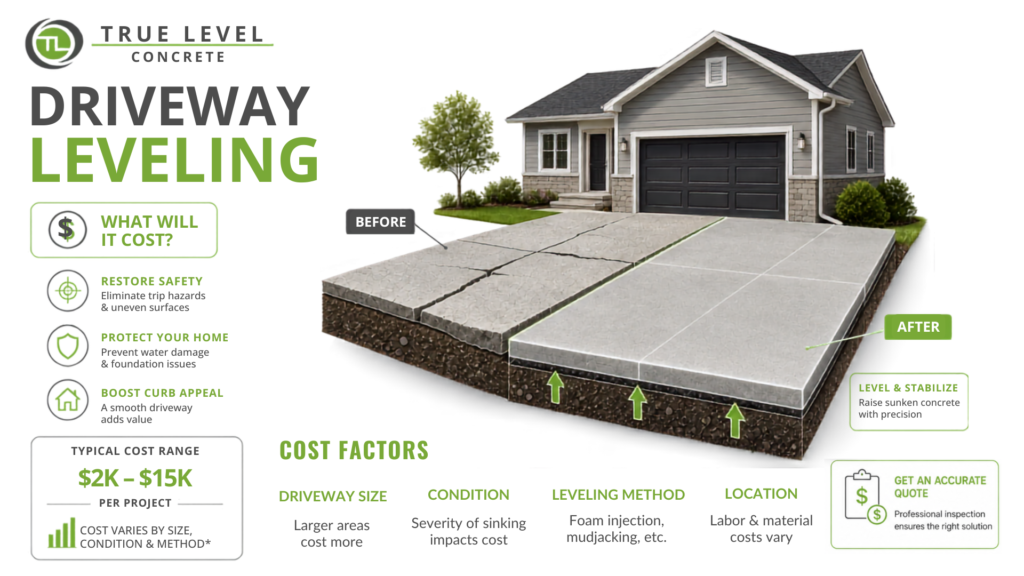
How much does driveway leveling cost? For most homeowners, the answer lands somewhere between $3 and $25 per square foot, but the full range stretches from a few hundred dollars for a small partial repair to over $7,000 for a complete driveway lift using premium polyurethane foam. You walk out one morning, notice the edge of your driveway has dropped an inch or two, and realize water is pooling near the garage and that lip has already caught your foot twice. The question isn’t whether to fix it. It’s what the fix is actually going to cost.
That range is wider than most homeowners expect because three variables drive it: the repair method, how much of the driveway has settled, and how severe that settlement is. This guide breaks down every major cost factor, compares all three repair paths with real price scenarios, and tells you exactly what to look for in a contractor quote. True Level Concrete offers free written estimates with no upfront obligation, so you can get real numbers for your specific slab before committing to anything.
What actually drives driveway leveling costs
Most of the price variation you’ll see between quotes comes down to four core variables. The repair method is the biggest lever, but job size, severity of the sinking, and site conditions all shape the final number in meaningful ways.
How much the slab has settled and over what area
A slab that has dropped half an inch requires far less material and labor than one that has settled three inches across a 400-square-foot surface. For both mudjacking and foam jacking, the severity of the drop determines how much material gets injected, and material volume is one of the clearest predictors of concrete slab lifting cost per square foot. Deeper voids mean more product, more injection points, and more time on site.
Driveway size: partial repair vs. full surface
Most contractors charge a minimum service fee regardless of job size, typically ranging from $600 to $1,200. That flat charge covers travel, equipment setup, and crew time. On a small partial job, that minimum represents a large share of the total bill and pushes your per-square-foot rate up sharply. As the repair area grows, those fixed costs spread across more square footage and the per-unit rate drops considerably.
Regional labor rates and site accessibility
Labor rates vary by metro area. Based on contractor pricing surveys, markets like the Pacific Northwest often run higher than the national midpoint. Tight access conditions, narrow side gates, overhanging landscaping, or vehicles blocking the work zone, add time and can push labor costs 15 to 30 percent above the baseline rate. Factor that in if your driveway is a tight or awkward setup.
How much does driveway leveling cost by method, mudjacking, foam jacking, and replacement
Each method has a different cost structure, a different lifespan, and a different set of trade-offs. Understanding all three helps you pick the right one rather than just the cheapest one.
Mudjacking: the lower-cost starting point
Mudjacking pumps a cement-soil slurry under the slab to raise it back up. It costs $3 to $8 per square foot on average, with full driveway jobs typically landing between $1,400 and $2,700. The trade-off is lifespan: mudjacking lasts 2 to 7 years in most conditions because the heavy slurry adds load to already-weak soil and erodes over time. Warranties on mudjacking work are short when they exist at all, and many contractors simply don’t offer one.
Polyurethane foam jacking: higher upfront, far longer-lasting
Foam jacking, also called polyjacking, uses a lightweight, expanding polyurethane foam injected through penny-sized holes that cures in about 15 minutes. The concrete leveling price for this method runs $5 to $25 per square foot, with full driveway jobs commonly falling between $3,000 and $7,500. The foam is waterproof, chemically stabilizes the soil rather than just filling voids, and carries a lifetime guarantee from most reputable contractors. It costs more per square foot than mudjacking upfront, but it rarely needs repeating.
Full replacement: the highest cost with specific use cases
Replacement runs $10 to $30-plus per square foot and is the most disruptive option, with cure times measured in days rather than minutes. For a structurally sound slab that has simply settled, full replacement is almost always the most expensive path with no additional long-term benefit over foam jacking. It makes sense in specific situations, covered in the section below, but for a slab that’s intact and just sunken, replacement is overkill.
What different job sizes actually cost: real price scenarios
Here’s how those per-square-foot rates translate into real numbers across two common job sizes. Use these as a starting benchmark before you call anyone.
How much does driveway leveling cost for small partial repairs (around 200 sq ft)
For a partial section repair of roughly 200 square feet, expect to pay $650 to $1,300 for mudjacking or $1,500 to $3,200 for foam jacking. The per-square-foot rate runs higher on these smaller jobs because the contractor’s minimum service fee represents a large portion of the total bill. A $1,000 minimum on a 200-square-foot job works out to $5 per square foot before a single injection is made.
Full driveway jobs (around 450 sq ft)
The cost to lift a sunken driveway at approximately 450 square feet typically runs $1,400 to $2,700 with mudjacking or $3,000 to $7,500 with foam jacking. The per-square-foot rate drops on these larger jobs because the fixed mobilization and setup costs get spread across more surface area. If you’re weighing whether to repair one section now or address the whole driveway at once, the full-driveway job delivers noticeably better value per unit.
What makes up your leveling estimate: labor, materials, and permits
Knowing the line items behind a quote helps you evaluate proposals intelligently and spot anything that doesn’t add up.
Labor is the biggest slice (50 to 70 percent of total)
A crew of two to four technicians handles prep, injection, and finishing. Labor is typically charged at $45 to $150 per hour or as a flat per-square-foot rate built into the project total. On a $4,000 job, labor alone commonly accounts for $2,000 to $2,800. That share increases on tight-access jobs where setup and maneuvering take longer than usual.
Materials and equipment (20 to 40 percent)
Mudjacking slurry materials run roughly $0.50 to $2 per square foot, while polyurethane foam materials cost $2 to $6 per square foot. Equipment rental and mobilization fees are often bundled into the labor rate but can appear as a separate line item ranging from $200 to $600. On foam jobs, the higher material cost shifts more of the total toward the materials column compared to mudjacking.
Permits and minimum charges (less than 5 percent, but watch for minimums)
Simple leveling jobs rarely require permits, but in stricter jurisdictions permit fees can reach $150 to $600. The more common hidden cost to watch for is the contractor’s minimum service charge, typically $600 to $1,200, which is standard practice but can catch homeowners off guard on small jobs. Always ask about minimums before the conversation goes any further.
When leveling won’t solve the problem and replacement is the right call
Spending money on leveling that won’t hold is a frustrating and avoidable mistake. There are clear conditions where lifting is not the right answer, and knowing them upfront saves you from calling the wrong contractor.
Concrete that’s too damaged to lift
If the slab is crumbling, spalling, or shattered into multiple pieces, it doesn’t have the structural integrity to hold the pressure of a foam or slurry injection. The material escapes through cracks rather than raising the slab. Extensive cracking across the surface tells the same story: the concrete has reached the end of its useful life, and lifting it won’t extend that life in any meaningful way. A slab that looks more like a puzzle than a solid surface needs to come out.
Heaving, tree roots, and subgrade failures
Leveling works by filling voids beneath a sunken slab. It cannot address concrete that has been pushed upward by tree roots, frost heave, or expansive clay. If the subgrade has eroded so severely that no stable soil remains to support injected material, no amount of foam or slurry creates a lasting repair. In these cases, the slab needs full removal and a proper subbase before any new concrete goes down.
- Tree roots that have heaved slabs upward require root removal before any repair
- Expansive clay soil that moves with moisture cycles will defeat leveling without drainage correction
- A driveway with a flawed original installation, poor slope, thin concrete, no reinforcement, needs replacement, not lifting
How to get an accurate estimate before you commit
A professional estimate should spell out the repair method, total square footage, material type and volume, labor cost, cure time, warranty terms, and a line item for any permit fees, everything a vague ballpark quote typically leaves out. Here’s how to tell a complete estimate from an incomplete one, and what to ask to get there.
Questions to ask any driveway leveling contractor
Ask each contractor which method they recommend and why, with a specific explanation tied to your slab conditions. Request a written breakdown of labor, materials, and any minimum charges before signing anything.
Find out how long the cure time is before the driveway is driveable again, and confirm exactly what the warranty covers and for how long. Any contractor who won’t answer these questions in writing is worth walking away from.
What a proper written estimate looks like
At True Level Concrete, free written estimates include all of this detail before any work begins, repair method, square footage, material volume, labor cost, cure time, and warranty terms, with no pressure to commit. That level of transparency gives you a clear picture of exactly what you’re paying for and why. When comparing quotes, any estimate missing these items leaves you open to surprise charges after the work starts.
The bottom line on driveway leveling costs
Raise and level concrete costs depend on four things: the repair method, job size, severity of settlement, and local labor rates. Mudjacking is the lower-cost entry point at $3 to $8 per square foot, but it needs repeating every few years. Foam jacking carries a higher concrete leveling price, $5 to $25 per square foot, but it delivers a much longer lifespan and a warranty that mudjacking almost never matches. Full replacement is the right answer only when the concrete itself has structurally failed.
For most homeowners with a sunken but intact driveway, foam jacking offers strong long-term value relative to its upfront cost. The next smart step is getting a free written estimate from a concrete leveling specialist so you have real numbers for your specific slab. That estimate will also confirm whether leveling is viable or whether replacement is the only path forward.
If you’re still asking how much does driveway leveling cost for your specific situation, a no-obligation written estimate from True Level Concrete is the fastest way to get a precise answer. It tells you the exact repair cost upfront, and whether leveling will hold, before you commit a dollar.